

Executive overview and scope
This football scouting guide defines football scouting as a connected system that turns player observation into repeatable recruitment decisions.
Executive summary: Effective scouting is not “watching talent.” It is decision engineering. The system works only when four links stay connected: observation creates evidence, evaluation assigns meaning, interpretation adds context, and decisions produce action.
This guide maps the full chain, shows where most clubs lose reliability, and links each step to deeper cluster articles so your reading follows the workflow of real scouting rather than a random browsing path.
The linked cluster articles reflect the complete scouting content system built across foundational, hybrid, and authority levels.
The real problem is not a lack of information. The real problem is a lack of connection between information and action.
How this football scouting guide maps the full system
Scouting is easiest to understand when you treat it as a pipeline with gates. Each gate exists to reduce uncertainty before money, squad planning, and coaching time are committed.
The pipeline starts with clarity. A club that cannot define its need cannot scout efficiently. “We need a striker” is not enough. The scouting brief must specify the role in the game model, the competition level, the age curve, and the acceptable risk profile. Without that, scouts search broadly, compare poorly, and recommend inconsistently.
Use the broad definition in what football scouting is as the entry point, then translate it into a role-specific brief. Role definition is where profile meets purpose.
Profile → role fit: a player profile is only valuable if it predicts role execution under your constraints. A profile that is not tied to role fit becomes biography, not scouting.
Modern scouting separates “where” from “what.” Position tells you where the player starts. Role tells you what the player must repeatedly deliver.
That distinction is why positional scouting should be treated as a coverage layer.
Selection should then be anchored to role-based scouting, where the profile is tested against the tactical job you actually need.
With the role defined, the system moves through a core chain:
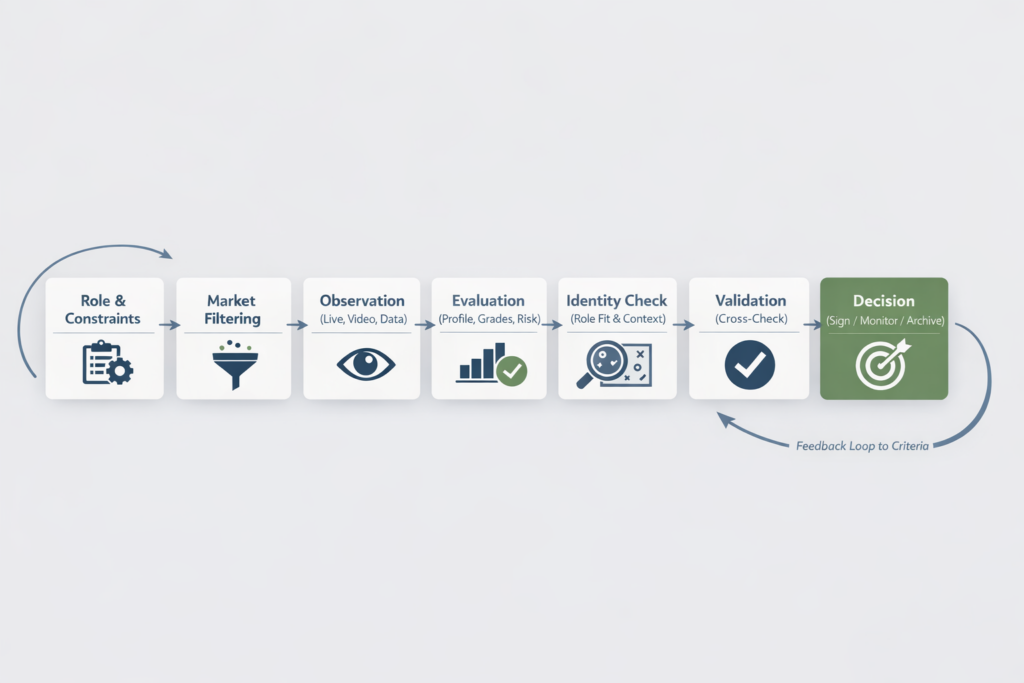
Observation → risk: observation is incomplete by default. A single match can inflate a player because of opponent weakness, tactical mismatch, or low pressure moments. If uncertainty is not labeled as risk, it silently becomes confidence and then becomes a costly decision.
Evaluation → decision: evaluation is not the endpoint. It is an input to action. If an evaluation cannot support a clear outcome, it is not an evaluation yet. It is notes.
Scouting methods exist because each answers a different question. Video helps you replay decisions. Live helps you see behavior that broadcasts hide. Data helps you filter large markets consistently.
| Method | Best for | Main risk if used alone | Where it fits in the chain |
|---|---|---|---|
| Video scouting | Repeatable review, action sequences, tactical patterns | Missing off-ball cues and match environment | Observation and evaluation |
| Live scouting | Off-ball movement, communication, intensity control, mentality under stress | Small samples and no replay, which amplifies first impressions | Observation and interpretation |
| Data scouting | Market filtering, benchmarks, trend flags across leagues | Context loss and role misuse when metrics are detached from game model | Filtering and risk checks |
This combination approach is consistent with FIFA’s published talent identification content, which highlights structured processes, observation environments, and analytics as complementary factors in identification systems.
UEFA’s scouting education materials frame modern scouting as a blend of match observation, recruitment management, reporting, and technology use rather than a single “eye test.”
Context is the bridge between what you saw and what it means. Match state, opposition level, team tactics, and competition tempo can flip the meaning of the same action. A winger completing dribbles in open space is not the same as a winger protecting the ball in a compact low block. This is why performance analysis frameworks emphasize interpretation that preserves the football context instead of isolating events.
| Context factor | What to record | Why it changes the judgment |
|---|---|---|
| Opposition quality | Pressure level, duel frequency, defensive spacing | Low pressure can inflate time on the ball and decision quality |
| Team game model | Pressing triggers, build-up structure, defensive line height | Role behaviors differ even within the same position label |
| Match state | Scoreline, momentum shifts, substitutions | Players often change risk-taking and positioning based on score |
| Competition tempo | Speed of transitions, time to pressure after first touch | Adaptation risk rises when tempo jumps in the target league |
FIFA’s Talent Identification Guide describes identification as a multi-dimension process that depends on how clubs structure their environment and evidence flow.
UEFA’s discussion on scouting in the age of AI reinforces that tools do not replace interpretation and that expert observation must still produce decision-ready insight.
A recent open-access review in Frontiers in Psychology summarizes how soccer talent identification criteria have shifted toward more integrative, multidimensional evaluation models over time.
Now define the evaluation layer. Good evaluation is structured, repeatable, and role-referenced.
Start by creating a stable player identity through player profiling. Profiling translates noisy match events into repeatable traits and tendencies. It creates a common language so different scouts can compare players over time without reinventing the criteria every match.
Then connect profile to projection through talent identification. Projection is where uncertainty is highest, especially in youth scouting. The practical implication is that your evidence must include “what is now” and “what is likely next,” and those are not the same question.
To keep observation broad, use a structured viewing template. A checklist is not meant to replace expertise. It is meant to prevent tunnel vision. Use a scouting checklist to ensure you cover technical, tactical, physical, and mental behaviors that relate to the role.
Metrics then become a support layer. The goal is not to “find the best number.” The goal is to confirm patterns and expose contradictions. Use metrics that matter to flag what deserves deeper viewing, then verify in matches. A metric is a question generator, not a conclusion.
FIFA’s work on football analysis language and data frameworks emphasizes context-led interpretation rather than event counting in isolation, which aligns with how scouting should use data as a lens rather than a verdict
At this point, many systems stall because they do not transform evaluation into a usable decision record. That is a documentation and governance issue. Scouts forget what they saw, departments cannot compare notes, and recruitment meetings turn into memory battles.
A repeatable process is defined in scouting workflow in football. Workflow connects identification, observation, evaluation, validation, and decisions so the club can scale beyond individual memory and still stay consistent.
Workflow breaks if evidence is not stored consistently. That is why organizing scouting notes matters. Notes are raw evidence. They should be time-stamped, context-tagged, and comparable across matches.
One practical way to keep the chain tight is to maintain a simple risk register alongside the player profile. The register does not have to be complex. It just needs to make uncertainty visible. Typical categories include adaptation risk, role risk, durability risk, and decision risk. For each category, define the next best test, such as “watch against a high press,” “watch in a low block game,” or “cross-check versus a different opponent style.” This turns uncertainty into a plan, and it prevents the decision meeting from becoming a last-minute argument.
This is where most clubs get it wrong: they treat risk as something you discover after signing instead of something you label and test before deciding.
Many clubs treat “more reports” as improvement. The output grows, but decision quality does not. Reports that do not connect to role criteria, risk, and an action state are administrative documents, not scouting tools.
A highlight is an outcome, but recruitment requires evidence of repeatable decisions, so you should grade behaviors that recur under changing constraints, not the moments that look best on video.
System principles
- Define the role and constraints before you watch, or you will evaluate the wrong behaviors.
- Label uncertainty as risk at the observation stage, not as confidence at the decision stage.
- Build player profiles from repeated patterns, not isolated moments.
- Turn evaluation into an action state: sign, monitor, or reject.
- Use validation steps to reduce bias before final decisions.
Applying the system to real work and real decisions
Scouting becomes valuable when the system produces decisions quickly and defensibly. That requires an operating rhythm that matches recruitment timelines and protects consistency across scouts.
Immediate effects: building a shortlist for a transfer window or trial period. The objective is speed with control. You are not trying to create the perfect report. You are trying to reduce a large market into a small set of decision-ready options.
Long-term effects: building a sustainable pipeline. The objective is reliability over time. Your criteria, templates, and validation steps should improve as feedback accumulates.
Start with match observation that captures patterns. Full-game viewing is essential because many role-critical behaviors are low visibility. Use a full match scouting process to track scanning habits, defensive positioning, reaction after mistakes, and whether the player maintains discipline when the game state changes.
Then convert what you saw into interpretation. Use a structured player analysis approach to connect actions to tactical meaning. This is where observation turns into evaluation, and where risk becomes explicit rather than implied.
Next, compare candidates properly. Comparison is not “who looked better.” It is “who best solves the role under our constraints.” Use a structured comparison method so your shortlist is role-referenced and consistent.
For youth scouting, add development logic. Youth performance is often distorted by early physical maturity, competition level, and exposure to high-quality coaching. Use a youth evaluation framework to separate current dominance from long-term indicators such as learning rate, decision stability, and adaptability.
When evidence is ready, convert it into a decision input with documentation that supports action. Use a report-writing workflow that forces four outputs: role fit, strengths that translate, weaknesses that create risk, and a clear recommendation. This is where evaluation becomes a decision tool rather than a description.
Now connect evaluation directly to action. Scouting decision-making should not be a meeting where opinions compete. It should be a process where evidence is tested against criteria and where risk is priced into the decision.
One simple improvement is to keep a short “decision record” for every final target. Record the final recommendation, the key assumptions, the top risks, and the evidence types used. After the player has been in the club for months, compare outcomes to that record. This tight feedback loop is how a department improves its templates and reduces the same mistakes in the next window.
If the process is fragmented → recruitment becomes inconsistent. If decisions are disconnected from reports → scouting loses value.
Validation protects the final gate. Use cross-checking in scouting to challenge the initial view, not to confirm it. A useful standard is to ask the cross-checker to answer a different question than the first scout, such as “What would break in our system?” rather than “Is he good?”
That validation step is easiest to maintain when the club is organized as a system. Use a scouting department structure to define who covers markets, who evaluates, who cross-checks, and who owns final recommendations.
| Layer | Primary responsibility | Key decision it supports | Common failure if missing |
|---|---|---|---|
| Coverage | Identify and monitor a wide pool | Who enters the pipeline | Late discovery and market blindness |
| Evaluation | Produce role-fit and risk assessments | Who reaches the shortlist | Superficial “good player” labels |
| Validation | Independent checks across contexts | Who becomes a target | Bias and small-sample decisions |
| Decision ownership | Align targets with strategy and budget | Who gets signed or monitored | Recruitment drift and inconsistent outcomes |
End-to-end example: identifying, evaluating, and deciding on a right winger for a possession team that presses high.
Identify: The club defines the role as a winger who can hold width, create separation in tight spaces, press with intensity, and make quick decisions in the final third. Data and video screening reduce the pool to candidates who show repeated attempts to beat defenders, consistent involvement in chance creation, and pressing activity that resembles the team’s trigger patterns. At this stage, the output is a candidate pool, not a signing list.
Evaluate: Video review checks whether the player’s decision-making holds under pressure and whether actions are created by skill or by low defensive quality in the league. Live matches confirm off-ball runs, body orientation before receiving, and emotional control after failed actions. The scout builds a profile with strengths, weaknesses, and explicit risk labels, such as limited evidence versus set low blocks or pressing consistency dropping late in matches. This is observation → risk, because uncertainty is recorded rather than hidden.
Interpret: The profile is mapped to role fit. If the player produces output but ignores pressing triggers, the role fit is partial and the development cost increases. If the player presses with correct angles, recovers quickly, and still maintains end-product, role fit improves. This is profile → role fit in practical terms.
Decide: The report ends with an action state. Sign if cost matches risk and behavior fits the model. Monitor if adaptation risk is high but upside is rare. Reject if recurring decisions conflict with the team model. This is evaluation → decision, and it makes the decision explainable to coaches and executives.
Structural example: organizing work inside a club so the same player is judged consistently.
Start by agreeing on role templates. Each template specifies key behaviors, disqualifiers, and acceptable trade-offs. Then assign coverage responsibilities by league or region so you do not duplicate work. Next, assign evaluation ownership so one scout is accountable for role-fit interpretation, while another scout cross-checks without inheriting the first scout’s expectation. Finally, define who owns the decision recommendation so you do not confuse “many opinions” with “one decision.”
Use the cluster articles in the same sequence the system uses. Start with roles and responsibilities, then methods, then evaluation, then operations and decisions.
If you are building your foundations, start with the scout role overview.
Then review the path to becoming a scout before you dive into workflow and department operations.
If you want a single hub to return to, bookmark this hub page and use it as your system map.
Choosing methods without creating false debates
Many scouting discussions become unproductive because they argue about tools instead of designing a process. Comparing approaches only helps when it clarifies trade-offs and improves decisions.
A useful starting point is to treat debates as sequencing problems. Video can narrow a pool. Live can validate the final candidates. Data can flag hidden markets and protect against bias. The question is not “which is best.” The question is “what does this step need to reduce uncertainty?”
One of the most common false debates is live versus video. Each is a different lens. Live tends to add context and behavior cues. Video tends to add repeatability and tactical detail. If you want a direct breakdown of trade-offs, use live scouting versus video scouting as the method comparison reference.
When systems fail, they often fail in the same predictable ways: highlights over patterns, opinions over criteria, and decisions made before validation. Use common scouting mistakes as a diagnostics list to spot where your chain is breaking and which gate needs reinforcement.
If roles are undefined → evaluation becomes subjective. That single error creates a cascade: scouting becomes inconsistent, comparison becomes noisy, and decisions become political instead of evidence-based.
Building a scouting system that stays connected
A complete system is not built by adding more scouts or more reports. It is built by connecting the chain so every observation can become evaluation, every evaluation can become interpretation, and every interpretation can drive a decision with explicit risk.
Most scouting systems fail because they confuse activity with structure. They watch, write, and meet, but they do not engineer how evidence becomes action.
Use this guide as a map, then deepen each component through the linked cluster articles. When your process stays connected, recruitment becomes consistent, explainable, and easier to improve over time.
That is the purpose of a football scouting guide, and it is the difference between finding interesting players and signing the right ones.