
Game model has become one of football’s favorite modern phrases. Coaches mention it in interviews, analysts debate it on timelines, sporting directors place it neatly into presentations, and clubs use it with the same public confidence people use when saying they have a long-term plan. The phrase is everywhere. Genuine understanding is not.
The problem is that game model is usually discussed backward. People start from the tactical picture they can see, then assume the explanation lives there. A pressing trigger here, a buildup route there, a few arrows on a formation board, and suddenly everyone feels strategically enlightened.
Nice visuals. Incomplete diagnosis.
Understanding game model in football begins much earlier than tactics. It begins with a simpler but far more revealing question: what behavior does a team keep repeating on average when football repeatedly asks the same questions?
Because that is what a real game model eventually becomes. Not a tactical catchphrase. Not a coach saying “we want to dominate” before watching his midfield turn into a public transportation terminal under pressure. A real game model is the organized repetition of average behavior under recurring match situations.
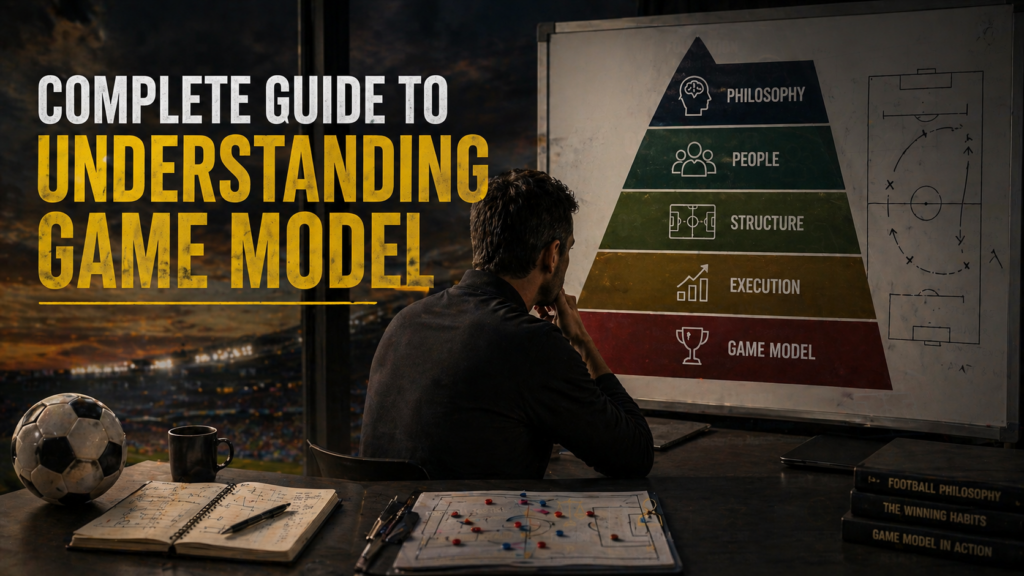
To understand game model properly, we have to go below the tactical surface and inspect the full football organism that produces those repeating answers.
Game Model Starts Long Before Tactics
“A bad system will beat a good person every time.”
W. Edwards Deming
Deming understood something football still tries to ignore. A good individual cannot repeatedly rescue a bad environment. His wider systems thinking principles were built for organizations, but they read like a warning label for football clubs that expect talent to cover structural confusion.
Before a team can produce repeating average behavior on the pitch, it needs invisible alignment off the pitch. This is where many clubs begin wobbling long before the first training pattern is installed.
A real football philosophy is the hidden decision framework behind football choices. It defines what risks are acceptable, what principles are non-negotiable, and what kind of football the organization is willing to suffer for when easy shortcuts become tempting. Everybody wants proactive football while winning comfortably. Philosophy becomes meaningful when losing 1-0 and the stadium starts producing amateur tactical experts by the thousands.
But philosophy alone is still too abstract if it remains decorative language. That is why defining a football philosophy matters so much. A philosophy only becomes useful when it creates clear constraints. What exactly are we trying to repeat. What exactly are we refusing to become. Which football habits survive panic.
Those repeated habits eventually create football identity. Identity is not temporary form. It is repeated behavioral memory. It is the reason some teams remain recognizable in ugly matches while others look like eleven men meeting for the first time every time adversity arrives. That is precisely why identity matters in football. It lowers behavioral randomness.
Then comes the environmental reality many football projects underestimate. Philosophy does not operate inside a vacuum. It lands inside a social ecosystem, which is why football culture matters. League habits, supporter impatience, academy traditions, player emotional defaults, and national football instincts all shape what kind of repeating average behavior is realistically sustainable.
So before one tactical pattern is rehearsed, a serious club already needs four stable answers:
- What do we believe?
- How specifically have we defined it?
- What identity are we trying to repeat?
- Can our football culture actually support that repetition?
If those answers are unstable, tactical work often becomes expensive theater.
The Visible Shape Is Not Yet the Real Model
This is where football often gets seduced by its own eyes.
Fans see a team circulating patiently, pressing aggressively, or attacking directly and quickly attach labels. Possession team. Vertical team. Counterattacking team. Intense team. These are descriptions of visible football. They are useful, but they are not the full explanation.
Playing style is what the eye notices first. It is the visible appearance of football behavior. But visible appearance can be deceptive. Two teams may both appear possession-heavy while one is calmly provoking pressure and the other is simply recycling the ball because nobody knows what progressive solution should come next.
This is exactly why scouts, coaches, and even analysts can misread teams if they stop at style. Scouts may overrate players who look clean inside harmless circulation. Coaches may copy visible patterns without copying the hidden references underneath. Fans may confuse short passing with tactical sophistication, which is football’s version of assuming glasses automatically create intelligence.
The crucial distinction appears in game model in football. Game model is not the visible pattern itself. It is the organized set of recurring solutions underneath the visible pattern. Style is the skin. Game model is the nervous system controlling what keeps happening when similar football problems return.
So understanding game model means moving beyond what looks familiar and asking what solutions are being repeatedly manufactured underneath the surface picture.
Every Game Model Depends on Better Decisions
“We are what we repeatedly do. Excellence, then, is not an act, but a habit.”
Aristotle
Aristotle was not discussing midfield support angles, but the principle travels well. Modern work on habit formation says the same thing in practical language: repeated behaviors shape reliable outcomes more than occasional intention.
Football models are often drawn as if players are obedient tactical markers. They are not. They are moving decision factories. Every few seconds they are reading pressure, scanning teammates, weighing risk, sensing time, and choosing between multiple imperfect actions. If those micro-decisions are poor on average, the tactical plan becomes a polite fiction.
This starts with football intelligence. Players must read situations before they can solve them. Space, opponent body shape, timing of pressure, available support, hidden danger, next action. The faster and cleaner this reading process becomes, the more likely the team is to produce repeating average behavior that looks organized rather than improvised.
Then comes decision-making in football. Intelligence reads the menu. Decision-making chooses the dish before the restaurant closes. Not every player who sees the right option selects it quickly enough, courageously enough, or consistently enough.
This is also a major scouting lesson. Scouts should not obsess over highlight actions only. They should ask: what decisions does this player repeat on average across recurring situations? Because game models are not built on once-a-month brilliance. They are built on repeatable average decision quality.
Football then adds one more layer. One smart player is useful. Eleven synchronized smart reactions are transformative. That is why collective intelligence matters. The back line steps together, the midfield compresses together, the support triangle appears before the passer begins his desperate search for human companionship.
A game model is therefore not simply tactical instruction. It is the repeated average synchronization of many compatible decisions under recurring football pressure.
Human Stability Is What Keeps the Model Alive
Now comes the inconvenient tactical truth. Human beings are involved, and human beings are notoriously unreliable when stress starts paying rent.
Players panic. They hide. They over-force. They lose courage after mistakes. They begin inventing emotional solutions to structural problems. This is where many beautifully prepared tactical plans quietly die.
That is why football mentality matters. Mentality is emotional stability under discomfort. Can players still trust the repeating average behavior when the game turns hostile, when they concede, when the crowd gets impatient, or when the opponent’s press starts feeling like an unpaid debt collector?
Winning mentality adds the competitive refusal to abandon collective order in decisive moments. This is not chest-beating mythology. It is the ability to keep useful football behavior alive when urgency starts shouting louder than reason.
Then enters leadership in football. Leadership is the human correction mechanism. It reminds the team what normal behavior should look like when the match starts pulling everyone toward abnormal reactions.
And because football becomes smoother when trust reduces hesitation, team chemistry matters too. Good chemistry does not magically solve tactical flaws, but it accelerates familiar interactions. Players spend less time verifying intentions and more time executing them.
This is the hidden truth: many teams do not lose their game model because the tactics disappear. They lose it because the people stop trusting the tactics when discomfort arrives.
Structure Turns Ideas Into Repeating Average Behavior
This is the center of the entire discussion.
Everything before this point prepares the internal conditions. Here, football begins converting those conditions into something measurable: repeating average behavior across recurring match situations.
That phrase matters enormously. Serious coaches, serious scouts, and serious analysts do not build around isolated peak moments. They build around what keeps happening on average when the same football questions return. That is the only behavior reliable enough to call structural.
The first guardian of this repetition is discipline in football. Discipline is the willingness to obey collective references repeatedly even when improvisation looks emotionally heroic. Hold shape. Delay the press. Keep lane integrity. Resist the temptation to become the star of a problem nobody asked you to solve.
Then football applies its lie detector: pressure in football. Pressure removes time, comfort, and false confidence. Under pressure, teams stop showing what they practiced ideally and start showing what they truly trust on average. This is why pressure is football’s truth serum.
Players must also know what recurring labor is expected from them, which is where role understanding in football becomes central. Position is geography. Role is repeated function. A left back, a six, or a striker can occupy the same location across teams and still be solving entirely different football jobs. Without role clarity, the same recurring situations keep receiving different recurring answers, and repeatability dies quietly.
Now comes the part many rigid tactical thinkers misunderstand. Repetition does not mean robotic cloning. A healthy game model also leaves room for creativity in football. But this creativity is useful novelty, not random theater. It is the unexpected but functional solution when standard routes become blocked.
Those solutions must then survive through adaptability in football. Opponents react. Spaces close. Pressing traps evolve. Build-up routes become readable. A living game model modifies the route without abandoning the identity every fifteen anxious minutes.
When discipline, pressure response, role clarity, creativity, and adaptability begin producing familiar average solutions over and over, one final visible outcome appears: consistency in football. Not perfection. Not guaranteed wins. Consistency means the team repeatedly lives inside a recognizable behavioral range regardless of venue, momentum, or temporary inefficiency.
And only here, after all these invisible and visible supports begin interacting, do we finally arrive at the actual game model.
The game model is not the first tactical layer coaches should talk about. It is the visible operational product of all the previous layers becoming stable enough to manufacture repeating average football answers.
This is why many clubs claim to have a game model the same way people claim to have a healthy sleep schedule. The ambition is present. The evidence remains under cross-examination.
The Five Tensions That Decide Whether a Game Model Survives
Building a game model is difficult enough. Keeping it alive is football’s longer cruelty because the model immediately enters five permanent collisions.
Freedom vs Structure
Freedom vs structure in football asks how much interpretive liberty players receive inside the shared skeleton. Too much freedom and repeating average behavior dissolves into personalized improvisation. Too much structure and the team starts playing like nervous office staff waiting for managerial approval to attempt a through ball.
Individual vs System
Individual vs system in football decides how much exceptional deviation a collective can safely absorb. Great individuals solve dead moments. They also occasionally vandalize spacing and timing. The art is deciding where genius is invited and where genius is politely told to stop freelancing inside rest defense.
Talent vs Hard Work
Talent vs hard work in football reminds us that not every repeating average behavior can be installed equally. Some capacities are trainable. Some are ceiling-dependent. Football keeps selling motivational optimism, but no poster has ever turned every limited scanner into an elite tempo controller.
Short-Term vs Long-Term Thinking
Short-term vs long-term thinking in football determines whether the club allows repeating average behavior enough time to mature. Two ugly Saturdays and suddenly the long-term project is buried under emergency signings, tactical overhauls, and dramatic speeches about standards.
This obsession with immediate visible intervention mirrors the corporate disease of short-termism, where organizations sacrifice future structure for present relief and then act surprised when tomorrow sends the bill.
Philosophy vs Results
Philosophy vs results in football is the final executive knife. The scoreboard always asks whether the organization still trusts the process when the table starts looking rude. Many do not. They uproot the machinery in pursuit of immediate fruit and then wonder why nothing stable keeps growing.
These five tensions are why a game model is never a completed tactical document. It is a living football compromise constantly being protected from collapse.
Why Most Clubs Never Truly Build One
“There is nothing so useless as doing efficiently that which should not be done at all.”
Peter Drucker
Drucker would have had an exhausting but entertaining life inside football boardrooms.
Most clubs do not fail because they never say the phrase game model. They fail because the ecosystem underneath the phrase remains unstable.
- The philosophy is vague enough to fit every bad week.
- The identity changes with every emotional storm.
- The roles are unclear enough for players to negotiate tasks in real time.
- The pressure responses are not deeply internalized.
- The leadership panics before repeating average behavior has enough repetitions to become trustworthy.
So the club keeps mistaking tactical edits for model construction. A new formation. A new winger. A new speech. A new committee meeting featuring very serious nodding.
Meanwhile the average behavior remains unstable, which means the game model remains theoretical rather than lived.
Many clubs do not have a game model. They have a rotating collection of weekly intentions.
Understanding Game Model Means Understanding the Whole Football Organism
“A system is never the sum of its parts. It is the product of their interactions.”
Russell L. Ackoff
Ackoff was speaking about systems. He might as well have been speaking about football. His lifelong work in systems thinking points to the same truth this entire guide has been circling: the quality of the whole comes from interaction, not isolated parts.
This is the final truth.
Understanding game model in football does not begin with tactical arrows and does not end with a formation board. It begins with philosophy, identity, and culture. It passes through intelligence, decision quality, and collective cognition. It survives through mentality, leadership, and chemistry. It becomes visible through discipline, pressure handling, role clarity, creativity, adaptability, and consistency. Then it spends the rest of its life wrestling with football’s permanent contradictions.
Only when those interactions begin producing the same average football answers under the same recurring football questions do we get something real enough to call a game model.
So the next time a club proudly announces it has one, the correct response is not applause.
The correct response is simple.
Show me your repeating average behavior.